Truth and Justice: The Two Wings of Lasting Peace
An Interview with His Beatitude Sviatoslav Shevchuk
As US President Donald J. Trump continues his effort to spearhead a negotiated peace in Ukraine, the head of the Ukrainian Greek Catholic Church, His Beatitude Sviatoslav Shevchuk, reminds the world that there can be no lasting peace without two essential elements: truth and justice.
Without recognizing the truth that Ukraine is a sovereign nation with its own language, culture, and identity, the Russian agenda of “Russkiy mir” (a “Russian world”) will continue to advance at the expense of Ukraine and other Western nations. Furthermore, by ignoring international law and the human rights of Ukrainians living in occupied territories like Crimea and the Donbas, any peace agreement will be merely a temporary pause in hostilities.
As the world observed the third anniversary of Russia’s full-scale invasion, His Beatitude Sviatoslav conducted a pastoral visit to the United States and Canada. He celebrated Divine Liturgies in Philadelphia and Washington, spoke at the Hudson Institute and the Institute for Peace, and met with a top official in the Trump Administration—just steps away from the Oval Office.
Aleteia spoke with him on March 19, following his return to Ukraine.
Aleteia: Your Beatitude, how would you assess your recent visit to the United States and Canada? What fruit do you think it will bear?
His Beatitude Sviatoslav: Perhaps we will see the fruits in the future; as a sower, one never knows how God will make the seeds grow or what kind of soil they will encounter. My feeling was that our Lord is currently giving His Church in Ukraine—and Christians in the US—a special role and vocation.
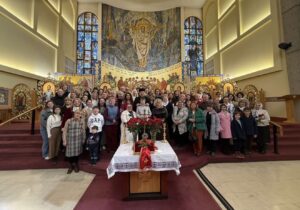
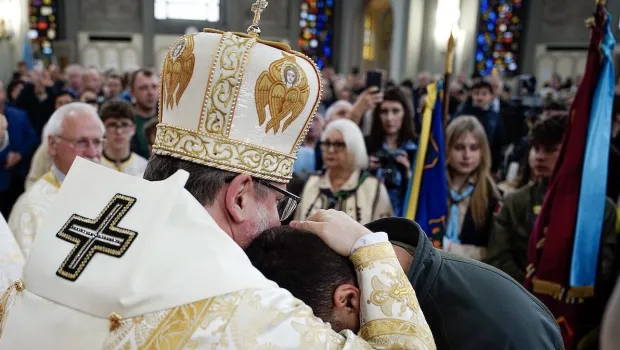
I tried to be a voice for simple Ukrainians. I spoke not only for Catholics or the Ukrainian Greek Catholic Church, but for civil society as a whole. It was a moment in which we, as the Mother Church from Ukraine, were able to embrace our people in the US. Simply embrace them.
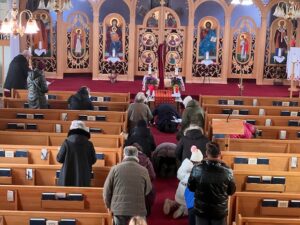
When I celebrated the Divine Liturgy in Philadelphia, it was the “Sunday of the Prodigal Son,” a day focused on the father’s embrace of the son returning home. It was very touching; thousands of Ukrainians came to the Metropolitan Cathedral for a Jubilee pilgrimage. Many spent the entire night in Confession. The priests were amazed, telling me they had never experienced anything like it on American soil.
I stood for almost two and a half hours offering personal blessings to each pilgrim. People waited in line for an hour with such sad expressions, but they went home with a renewed sense of hope. It was my duty to be a witness of Ukrainian hope to the faithful and people of good will in the USA.
What was your conversation like at the White House?
His Beatitude Sviatoslav: We were the first Ukrainian delegation to visit the White House after the inauguration. We were received by Paula White-Cain, head of the newly established White House Faith Office. The setting was very symbolic—the Roosevelt Room, just beside the Oval Office.
We spoke about religious freedom, especially in the occupied territories. I discussed the liberation of our two Redemptorist priests, Frs. Ivan Levytsky and Bohdan Heleta, who spent 18 months in Russian captivity. I also spoke for the Protestant pastors still being held, interceding for their liberation.
I stressed that for Christians, Jews, and Muslims, “Ukraine” means freedom, while “Russian occupation” means persecution. I provided clear examples of the destruction of churches in occupied areas. Her response was positive; she expressed interest in staying in touch with Metropolitan Borys Gudziak and the Ukrainian Catholic University to remain well-informed on these issues.
How do you view President Trump’s approach to Russia in his attempt to bring peace?
His Beatitude Sviatoslav: First, we must admit that we often do not fully understand these actions, perhaps because we don’t know what is happening behind closed doors. It may not yet be the time to interpret every gesture.
Second, it is positive that the administration speaks about ending the war. We have been dealing with this for over 11 years, and we long for the aggressor to be stopped. However, there is a third concern: a fear that people expect a “quick and simple” solution to a very complex, long-term issue.
There is a profound lack of trust toward Russia. History shows that whenever Russia uses the diplomatic route, the agreements are soon broken. In 2022, the Russian Ambassador to the Holy See assured the Holy Father that talk of an invasion was a lie—weeks before the full-scale attack began. Even recently, on the same day media reported Putin might stop attacks on infrastructure following a call with President Trump, Ukraine was heavily attacked by Russian drones.
To achieve a sustainable, authentic peace—not just a frozen conflict—we must speak about justice and truth.
Some in the administration suggest it is “unrealistic” for Ukraine to recover the 20% of its territory currently occupied. How do you respond?
His Beatitude Sviatoslav: Let me comment as a bishop who cares for people. We are realistic, but we should not be focused solely on territorial negotiations. Russian propaganda wants the world to believe Ukraine is simply “land.” But Ukraine is a people.
How can we negotiate the life and death of the people left in occupied territories? Who will protect their human rights, their children, and their faith? My proposal to the White House was to bring human rights back to the table, not just minerals or soil.
Russia is not fighting just for land. They are fighting for the ability to rewrite the world order and interfere in the internal affairs of the US, Canada, and Europe. If a deal “appeases” the aggressor, it allows that poison to spread.
Where do Ukrainians find hope today, especially as foreign military aid is being debated or cut?
His Beatitude Sviatoslav: For Ukraine, defending ourselves means surviving. We have no choice. We will protect our homeland with or without foreign help. Our hope is in God and in our own resilience.
History has shown this three times. In 1991, we voted for independence when the world told us to stay with Moscow. In 2013, Ukrainians died on the Maidan for European values. And in 2022, the world gave us three days to survive; we have withstood three years.
We did not receive military assistance because we were promised it; we received it because we proved we were able to prevail. The sovereignty and freedom of Ukraine are not subject to negotiations. That is our red line.
Pray for us. And come visit us in Ukraine—you will see our hope for yourself.